

A diagnostic in session — the partners’ table, Congress Avenue
Corporate & Management Consulting · Est. 2004 · Austin, Texas
Hard problems, clearly solved — and actually finished.
Senior partners lead every engagement. Nothing is handed off.
Halden & Grey works with established companies on the decisions that determine the next decade: where to grow, how to operate, and how to organize for both.
This page is one engagement, worked in the open — from the client’s first sentence to the signed diagnostic. You are sitting in.
The Session
One engagement, five sittings — the whole session is worked in the open below.The Brief In session
The problem, exactly as the client states it.
The Diagnostic In session
Weeks 1–3 · the wall fills, in front of the client.
The Argument In session
Options costed and argued in the room. One is refused, out loud.
The Build In session
Embedded with the client’s own people, on the floor.
The Handover In session
Measured against the diagnostic — then the firm leaves.
First Sitting — The Brief
“We make a good product. We just can’t get it out the door. Every order ships late — and my plant managers and my sales team tell me two different stories about why.”
The owner — a Texas manufacturer · clients are referenced by industry only
That was the whole brief: one sentence of fact, one of friction. No partner answered it in the room. The brief is taken down exactly as stated — the diagnosis comes later, and it comes from the client’s own ground.
The diagnostic that follows starts — in the firm’s own words — “with your data, your customers, and your front line — not with a hypothesis we brought with us.”


Second Sitting — The Diagnostic · Weeks 1–3 · Fixed Fee
Diagnosis before prescription. Always.
Every engagement follows the same discipline, whether it lasts six weeks or eighteen months. It is deliberately unglamorous — and it is why our recommendations get implemented instead of shelved.


Thomas Halden — Managing Partner
Founded the firm in 2004 after leading operations strategy for two industrial groups. Thomas still leads the diagnostic phase personally on every major engagement — this one included. The wall is his instrument: the client’s own numbers, pinned up where everyone has to argue with them at once.
Focus — Corporate Strategy · Operations · Industrial & Manufacturing

The diagnostic wall
What three weeks put up. Every finding went on the wall in front of the client — nothing was held back for a report.
The late orders are not a capacity problem
Output met demand in nine of the last twelve months. The work was there; the sequence was wrong — orders waited on parts of the plant that were never the bottleneck.
Changeovers eat the week
Eleven hours a week go to changeovers the schedule budgets at four. Nearly every late order traces back to that single gap between the plan and the floor.
Both stories were true
Sales promised dates from the order book. The floor worked from the machine board. Nobody had ever put the two on the same wall — so both were right, and the orders were still late.
One machine carries the plant
Every product passes through a single press at the plant’s centre. It runs at 94% while the plant around it runs at 70 — the whole schedule is a queue for one machine.
A finding about the firm
Two of the four practices we sell would not have helped here. The diagnostic says so, in writing, before any fee beyond the diagnostic itself was discussed.
The two stories, on one wall
ThroughputLead timeTwelve months of the client’s own numbers — the order book and the machine board, plotted together for the first time.

Eleanor Grey — Partner, Strategy & Growth
Eleanor leads the growth practice, advising boards on portfolio and market-entry decisions. Her work is known for saying no — clearly, early, and with the evidence attached. The finding about the firm was hers to deliver, and she delivered it herself.
Focus — Growth Strategy · M&A Support · Healthcare & Services
The diagnostic is shared in full — including what it says about our own fit for the work.
Third Sitting — The Argument · Weeks 3–5 · Joint Decision
We recommend one course of action.
Options are costed, sequenced, and argued in the room with your leadership team. We recommend one course of action and state plainly what we would not do — and why.

The recommendation was one course of action. The refusal was part of it — argued in the room, not buried in an appendix.
Fourth Sitting — The Build · Months 2–6 · Embedded Team
The plan becomes operating reality.
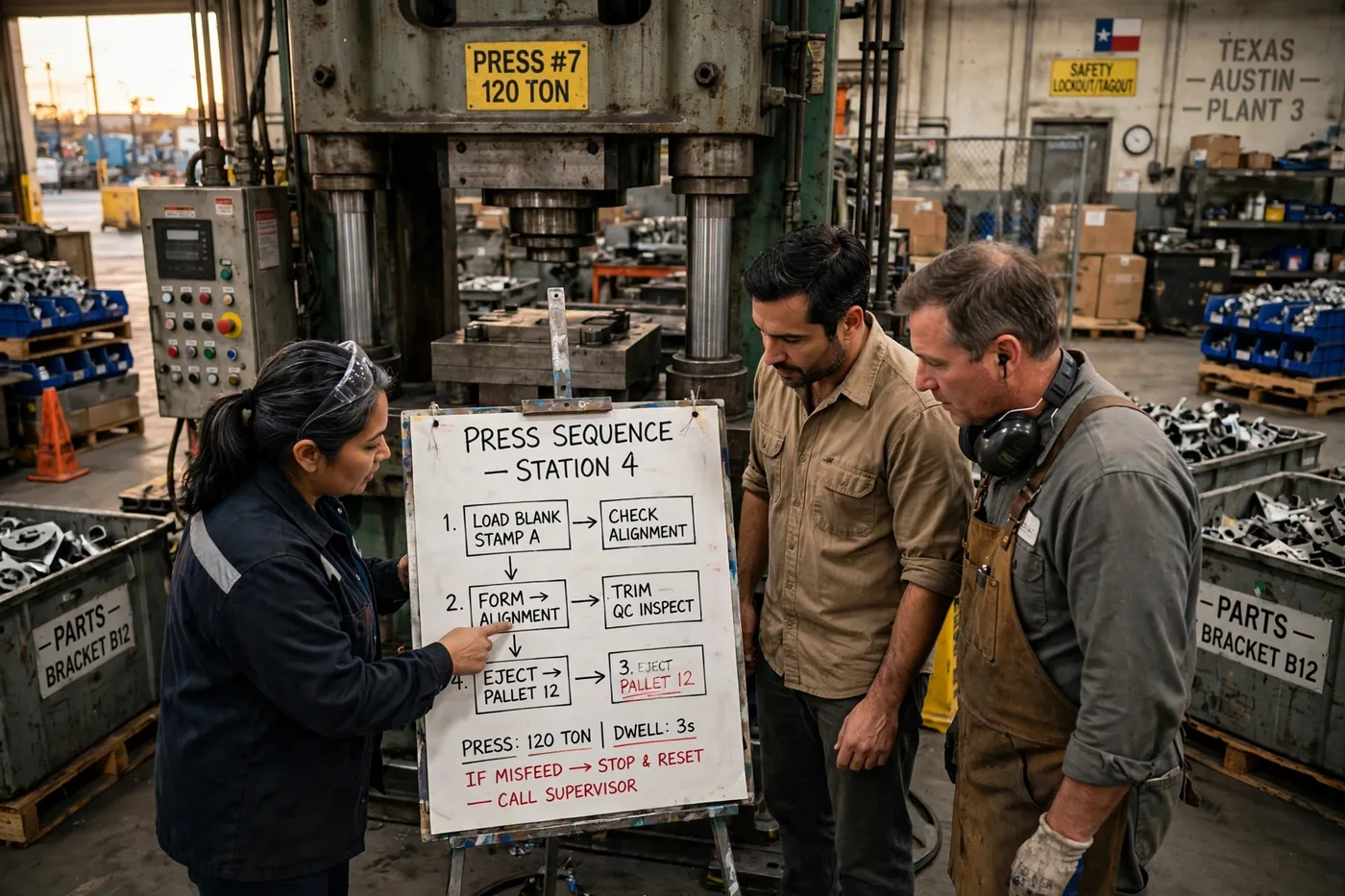
Our partners stay embedded while the plan becomes operating reality: new processes, structures, and routines designed with the people who will run them.
James Whitmore — Partner, Organization & Digital
James leads organization design and the digital practice, joining the firm in 2011 from a national logistics operator where he ran transformation from the inside. His builds start on the floor, with the people who will run them — this sequence was drawn at the press, not in a conference room.
Focus — Operating Models · Change · Data & Automation
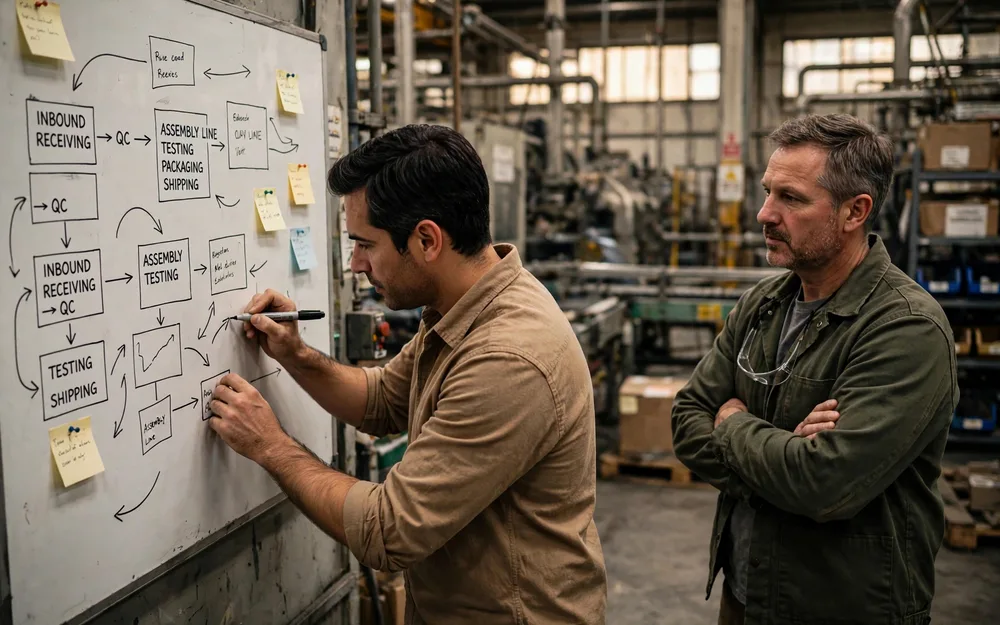
The new sequence, drawn once
Drawn on the plant floor, in marker — one line, in the order the work actually moves.
The sequence the diagnostic argued for — the press scheduled first, and everything else in its order
Fifth Sitting — The Handover · Final Phase · Measured Handover
Measured at handover, not at the pitch.
Every figure below is drawn from completed engagements and verified against the diagnostic baseline before we leave. Industry detail is given in aggregate to protect client confidentiality.
Engagements
Across 14 industries since 2004.
Client Retention
Of clients in the last five years returned for a second engagement.
Median Cost Reduction
Median sustained operating-cost reduction in performance engagements at 12 months.
Plans Fully Implemented
Of agreed recommendations in place at handover — the metric we are judged on internally.

We measure against the baseline from the diagnostic, hand over the dashboards and the habits, and leave. A good engagement ends with your team stronger — not dependent.
Outcomes, by industry.
Manufacturing
Throughput up 24% and lead times cut by a third across a multi-plant footprint, without headcount reduction.
Healthcare Systems
Service-line redesign reduced patient wait times 31% while holding staffing flat through two years of volume growth.
Financial Services
Post-merger operating model delivered in nine months; duplicate functions consolidated with retention of key teams above 95%.
Client work is referenced by industry only; Halden & Grey does not publish client names.
Partners who do the work.
Halden & Grey is partner-led by design. The person you meet in the first conversation is the person accountable at handover.
Thomas Halden — Managing Partner
Focus — Corporate Strategy · Operations · Industrial & Manufacturing
Eleanor Grey — Partner, Strategy & Growth
Focus — Growth Strategy · M&A Support · Healthcare & Services
James Whitmore — Partner, Organization & Digital
Focus — Operating Models · Change · Data & Automation
The Practice
Four practices. One accountable team.
Most engagements touch more than one practice. You get one partner, one team, and one plan — not four separate workstreams competing for your calendar.
Corporate Strategy & Growth
Where to compete · How to win
Portfolio choices, market entry, and growth strategy grounded in evidence — not trend decks. We pressure-test the plan against your real capacity to execute it.
- Growth strategy
- Market entry
- Portfolio review
- M&A support
Operations & Performance
Cost · Quality · Throughput
Margin and performance improvement that survives contact with the shop floor and the service line. We work inside the operation, alongside your teams, until the numbers move.
- Cost transformation
- Supply chain
- Service operations
- Procurement
Organization & Change
Structure · Leadership · Adoption
Operating models and restructures designed around how work actually gets done — with the leadership alignment and change support to make them stick.
- Operating model
- Org design
- Change management
- Leadership alignment
Digital & Analytics
Data · Automation · AI readiness
Pragmatic digital work: fix the data, automate the obvious, and sequence the ambitious. No platform sales, no pilots that never scale.
- Data strategy
- Automation
- AI readiness
- Systems selection
Trusted across — Manufacturing · Healthcare Systems · Financial Services · Logistics · Energy · Business Services
Insights
Thinking, in plain language.
Short briefings from our partners on the questions boards and operating leaders ask us most.
The Strategy Isn’t the Plan on Paper
Most strategies fail quietly — not in the boardroom, but in the hundred small resource decisions made afterwards. How to close the gap between the plan and the calendar.
Read the briefing
Every leadership team can point to the strategy document. Far fewer can point to the moment it changed a decision. In our diagnostics, the most common finding is not a weak strategy — it is a sound strategy that quietly loses every resource fight that follows it: the budget round, the hiring plan, the calendar.
The fix is unglamorous. Translate the strategy into a short list of explicit trade-offs — what will get less, not just what will get more — and review those trade-offs monthly, in the same meeting where resources are actually allocated. A strategy that never appears in that room is a poster, not a plan.
We ask clients to run one test before any strategy launch: pick three recent, real decisions and check them against the stated priorities. If fewer than two align, the work ahead is not communication. It is governance — and it is entirely fixable.
Cost Programs That Don’t Cost You the Business
Cutting cost is easy. Cutting it without cutting capability is the work. Three tests every savings target should pass before it is announced.
Read the briefing
Cost programs fail in a predictable way: the savings are real, and so is the damage. Response times slip, the best people leave first, and within two years the cost returns — now attached to a weaker business. The problem is rarely the target. It is the order in which cuts are chosen.
Before any target is announced, we apply three tests. Does the cut remove work, or merely squeeze the people doing it? Does it touch anything a customer would notice within ninety days? And can it be sustained for three years, or is it a one-year deferral dressed as a saving?
Programs that pass all three tests look slower in month one and dramatically better by month twelve — because they removed complexity instead of capacity. That distinction is the whole discipline.
Reorganization Is a Last Resort, Not a Strategy
New boxes on a chart rarely fix old problems. When structure really is the issue — and the cheaper questions to ask first.
Read the briefing
A reorganization is the most expensive way to solve most problems: months of uncertainty, quiet attrition of exactly the people you wanted to keep, and — too often — the same bottlenecks wearing new titles. Yet it remains the first lever many leadership teams reach for, because it is visible and feels decisive.
Before redrawing a single box, we ask three cheaper questions. Are decision rights clear, or does everything escalate by default? Do incentives reward the behavior the structure is blamed for lacking? And would the problem survive a honest look at workload — is this a design issue, or a capacity issue?
Sometimes structure genuinely is the answer, and then we design it properly: around workflows, not personalities, with transition support measured in months. But in our experience, roughly two of three proposed reorganizations are solving a different problem than the one on the chart.
Start
Start with the diagnostic conversation.
An hour with a partner, no pitch deck. Bring the problem as you see it; we will tell you honestly whether — and how — we can help, and what we would do first.
Office
1200 Congress Avenue, Suite 1840
Austin, TX 78701
Phone
Hours
Monday – Friday, 8:30 a.m. – 6:00 p.m. CT
Partner consultations by appointment
A partner — not a sales team — reviews every request and responds within one business day.
Halden & Grey · 1200 Congress Avenue, Suite 1840, Austin, TX 78701 · (772) 555-0147